
Dithyramb
Dithyramb is a sound sculpture that was conceived during a discussion I had with a physicist on how I perceive the engagement of two bodies interacting with each other and the power structures their social interaction forms. The prototype of this work took form in Besançon, FR during the artist residency at ISBA – Institut Supérieur des Beaux-Arts de Besançon (2017).
Dithyramb is an extension of the body, made out of wood, a leather corset-harness, contrabass strings, black horse-riding helmet, and metallic, acrylic, and electronic components. It is considered a string-based instrument and can be attached to effect pedals, synthesisers, sound mixers, soundcards, and music software. Dithyramb consists of five main separated parts that are attached to each other and can be performed when the performer wears the corset-harness, and allow their body to fall backwards in a diagonal axis (partly hanged), thus creating a force opposing the wall’s direction. To initiate sounds out of the contrabass strings, the performer needs to put an additional force, tension, pulling and weight towards the same direction, opposing the wall. When the right amount of force, tension, pulling and weight is applied, the performer is ready to play.
Through body movements and the performer’s weight, dithyramb’s sounds vary in tonality, pitch, timbre, frequency and the producing of tremolo. With body movements, the performer has the ability to initiate and develop pressure fluctuations that travel outward (sound wave) and cause the performer’s body to vibrate and produce different qualities of sound. The sounds created by the performer’s physical weight vary due to some parameters that are introduced by the instrument’s neck choice and its positioning on the wall. The first parameter concerns the height of the instrument’s placement in relation to the performer’s height, and the second concerns the minimum tension (70 kg) that needs to be applied in relation to the performer’s physical body weight. Both parameters, especially the second, concern the amount of force and pulling the performer applies to reach the standard of 70 kg.
The instrument’s sounds vary depending on the physical weight of the performer who performs the required tension, attached with the movement of the body that allows tremolo and changes in pitch to occur. Dithyramb has been previously used in experimental and noise events to explore questions of how perception changes information; proposing that a pre- identification of objects exists in a situation where perception in noise happens.
score 01 (for one performer)
Strap yourself inside dithyramb and feel the tightness and the weight of the structure in your body. Let your body fall back, lose the sense of its weight. Let yourself tune with the strings. Allow your body’s angle to create its own axis and sense of gravity. Use the axis of your body and the tension of the strings as your guide to delve into the communication between yourself and the sounds. Feel the vibrations of the sounds within your body and let the intact part of yourself move with the sensation of the sound. Allow yourself to transform and give birth to its own tragedy. Dithyramb is your channelling with intoxication. Through this intoxication allow yourself to become the horse in Nietzsche’s breakdown. Allow yourself to communicate your dialectic monologue. Find the supremacy of that communication and allow it to become your catharsis.
Special thanks to the Theatre Academy of University of the Arts Helsinki for all the sources, facilities and assistance throughout the project. Special thanks to Anne Lehto for developing the leather harness.
Courtesy the artist
Copyright © 2017-2019 by Nicolina Stylianou. All rights reserved. Reproduction in whole or in part, by any means, without written permission is prohibited.
-
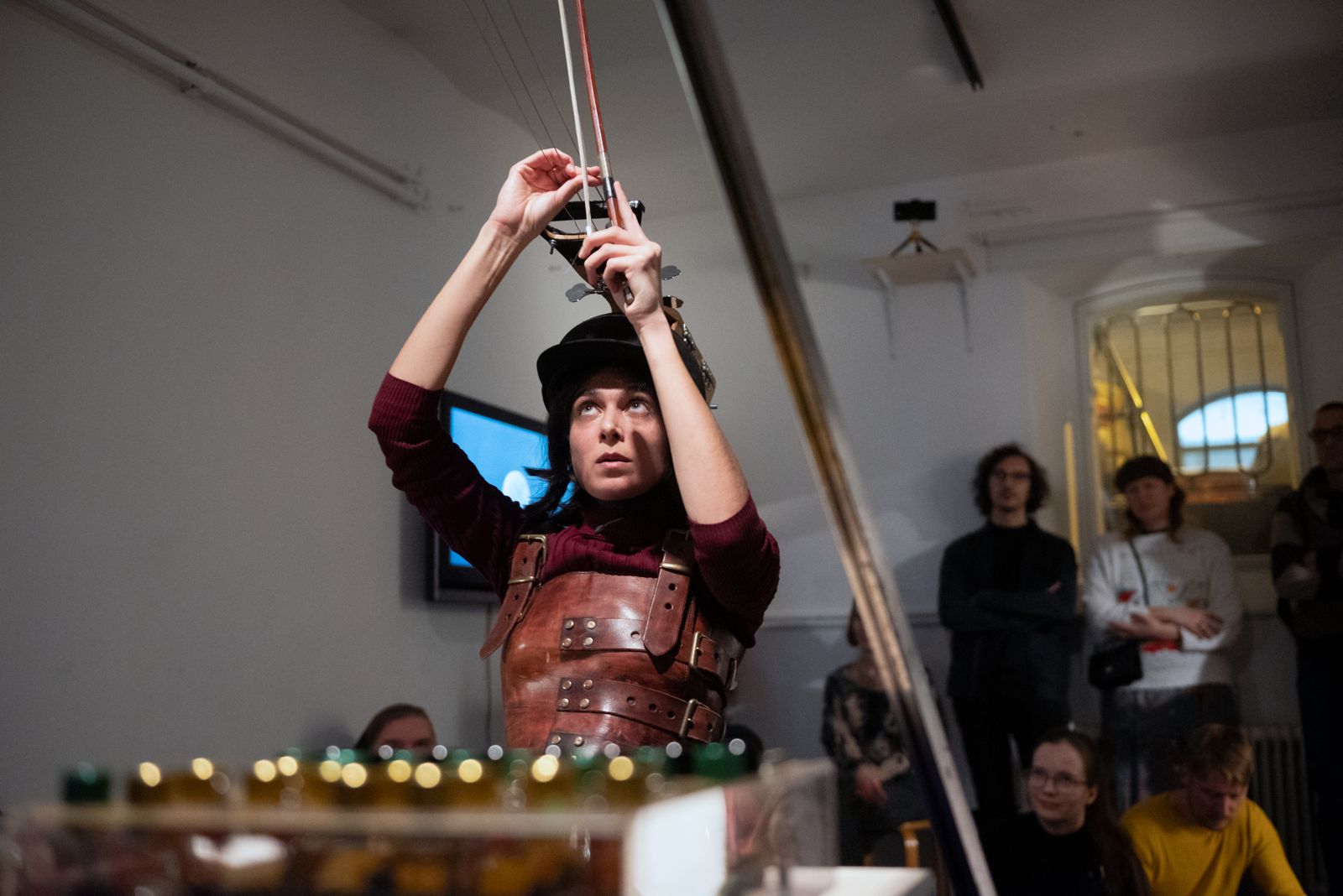
Microtonal Music Studios
photo: @kamila_sladowska
-

Conjoined Fugues
Conjoined Fugues is the second part of a happening which imagines Nietzsche’s breakdown and creates a narrative where Nietzsche (the audience) visits his mental breakdown once again under an indeterminate derealised state, a state of mind where reality ruptures. Through Nietzsche’s imagined breakdown, the four body-sculptures emerge and take agency…
-

Social Sculptures – Beuys100
Within the framework of Beuys100, the Goethe-Institut Cyprus presents the project Social Sculptures: a series of events curated by Marina Christodoulidou. The events programme includes an exhibition, which resulted from a workshop with local artists, guided tours, film screenings, an online discussion with art historian Rhea Thönges-Stringaris, and a round-table…
-

Mind Split = Identical Twins
This phase of the project focuses on the collection of women’s hair alongside storytelling. The act of collecting hair is informed by ideas of genetic transmission across generations. Coming from Nicosia, Cyprus, one of the few divided cities in the world, I situate the work within the context of inheritance.…
-

Thought Compositions
Thought Compositions is a participatory performance that explores authorship, bodily endurance and suspension, and the transmission of intention through sound. The work was presented for the first time in Besançon, France, as part of the Excentricités VIII: Corps désirants / Corps délirants Festival, curated by Julien Cadoret and Louise Vanardois. The performance invited members of the…